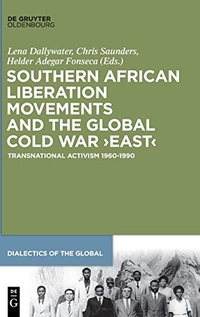
In englischer Sprache. In the global context of the Cold War, the relationship between liberation movements and Eastern European states obviously changed and transformed. Similarly, forms of (material) aid and (ideological) encouragement underwent changes over time. The articles assembled in this volume argue that the traditional Cold War geography of bi-polar competition with the United States is not sufficient to fully grasp these transformations. The question of which side of the ideological divide was more successful (or lucky) in impacting actors and societies in the global south is still relevant, yet the Cold War perspective falls short in unfolding the complex geographies of connections and the multipolarity of actions and transactions that exists until today. Acknowledging the complexities of liberation movements in globalization processes, the papers thus argue that activities need to be understood in their local context, including personal agendas and internal conflicts, rather than relying primarily on the traditional frame of Cold War competition. They point to the agency of individual activists in both "Africa" and "Eastern Europe" and the lessons, practices and languages that were derived from their often contradictory encounters. In Southern African Liberation Movements, authors from South Africa, Portugal, Austria and Germany ask: What role did actors in both Southern Africa and Eastern Europe play? What can we learn by looking at biographies in a time of increasing racial and international conflict? And which "creative solutions" need to be found, to combine efforts of actors from various ideological camps? Building on archival sources from various regions in different languages, case studies presented in the edition try to encounter the lack of a coherent state of the art. They aim at combining the sometimes scarce sources with qualitative interviews to give answers to the many open questions regarding Southern African liberation movements and their connections to the "East".
Rezensionsnotiz zu
Frankfurter Allgemeine Zeitung, 25.02.2020
Rezensent Jürgen Zimmerer bekommt mit dem Band von L. Dallywater, Ch. Saunders und H.A. Fonseca einen Hinweis darauf, wie eine globalisierte Forschung zum Kalten Krieg aussehen könnte. Dass der Band nur Schlaglichter wirft, keine umfassende Darstellung liefert, ist ihm klar. Wie aber Bündnispartner der Supermächte im Kalten Krieg agierten oder die DDR den ANC unterstützte, lernt Zimmerer aus den enthaltenen Aufsätzen und erhält Eindrücke von der Vernetzung zwischen Kairo und den Ostblockstaaten.
Nelio Biedermann: Lázár Alles beginnt, sogar das Ende, als Lajos von Lázár, das blonde Kind mit den wasserblauen Augen, zur Welt kommt. Seinem Vater, dem Baron, wird der Sohn nie geheuer sein, als… Heike Geißler: Michaela Kohlhaas "Das Rechtgefühl machte ihn zum Räuber und Mörder." So erzählt es Heinrich von Kleist in seiner gleichnamigen Novelle über den Pferdehändler Michael Kohlhaas, der nach erlittenem… Robert Seethaler: Die Straße Die Straße ist nicht im Zentrum der Stadt und nicht an ihrem Rand. Versteckt liegt sie irgendwo dazwischen. Kein Besucher würde sich dorthin verirren, und doch passiert in… Petra Morsbach: Orion Nora lernt bei einem Studentenjob ihren späteren Mann kennen, einen Archivar. Sie wird Lehrerin für Deutsch und Geschichte in einem oberbayerischen Gymnasium, zieht einen…





 Nelio Biedermann: Lázár


 Heike Geißler: Michaela Kohlhaas
 Robert Seethaler: Die Straße
 Petra Morsbach: Orion